
The most famous site in Athens – if not Greece, if not the world – is of course the Parthenon on the Acropolis. It’s what you do when you go to Greece. But perhaps it is telling that the first post I write on Greece does not focus on the Acropolis, nor does it delve into Athens with its ancient and modern dichotomies, bustling streets, and overflowing souvenir shops. It’s not about Greek food in its fresh, bright simplicity, or Greek wine and its honeyed history. It’s instead a mountainside two hours north of the city, covered in crumbling ruins and once considered the center of the known world. No matter what you believe, there is no question that it is a powerful and sacred place, whether due to the breath of Apollo or simply the accumulation of human belief and veneration over millennia. This is the ancient site of the Oracle of Delphi.
From Athens to Delphi
Greece lacks robust public transportation. Given its 6,000 islands and 80% mountainous terrain, it’s understandable why there isn’t an extensive rail network. For a solo traveler without a car, however, it makes it more difficult to see more obscure sites. Consequently, despite my general aversion to organized tours, it was by far the easiest way to visit Delphi on a day trip from Athens.
I usually dislike tours – there is something so undignified about following someone holding up an umbrella or bandana on a stick, climbing on and off a giant tour bus all day and being herded around like sheep. However, there are times where it is far easier to have a tour company do all the hard work. Having someone pick you up, guide you to notable sights with a well-tested itinerary, provide extensive information about the country and its landmarks, and then return you home can be quite convenient. I find that small-group tours, like the one I took to Delphi, offer a great compromise that doesn’t break the bank.
Delphi is about two hours from Athens, but driving through the Greek countryside is far from monotonous. The plains of Boeotia outside Athens are quite flat and covered in farms—wheat, cotton, corn. The cotton was ready for picking as we passed through, with fields carpeted in green and white. Passing trucks left floating fluffs in their wake, the harvest pieces whipping away in the strong breeze. Surrounding the plains on all sides were mountains, and as we approached the foothills, many hillsides were charred and blackened from recent wildfires—a persistent threat given the dryness of the season.
The foothills soon gave way to Mount Parnassus, another mountain besides Olympus that makes a name for itself in many myths and stories. Sacred to Apollo and the Muses, and also to Dionysus and his mysteries, it reminded me strongly of Liguria with its steep slopes and patches of craggy rocks poking through carpets of silver-green. I’m enamored with the silver-green sheen of olive tree leaves that impart an otherworldly feel to the landscape.
Archaeological Museum of Delphi
Our first stop was the Delphi museum, at the entrance of the site below the Sacred Way and Temple of Apollo. Housed with numerous artifacts across thousands of years of history, there were three artifacts that easily stood out for me above the rest.
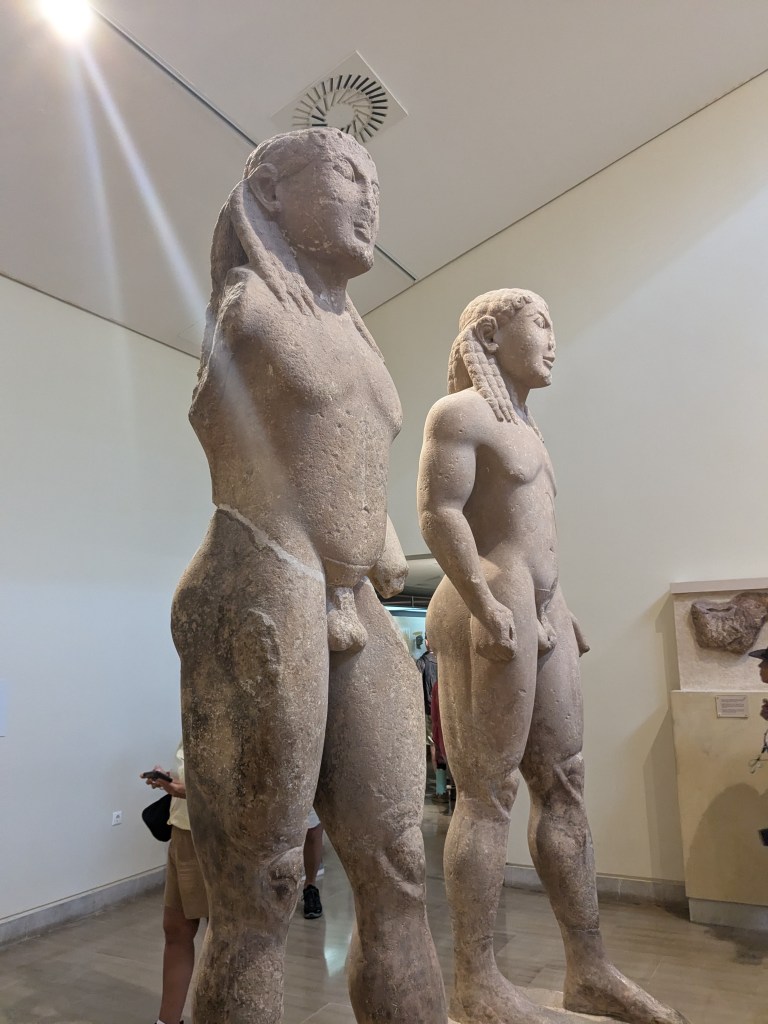
First were the Twins of Argos. Central to a story first told by Herodotus in the 6th century BCE, Kleobis and Biton were sons of Cydippe, a priestess of Hera. During a festival dedicated to the goddess, when no oxen could be found to pull the cart of offerings to her temple, the two brothers yoked themselves to the cart and pulled it up the hill, refusing all help despite the difficulty. Cydippe prayed to Hera to grant her sons a great gift for their devotion. Hera, pleased with them (and herself, to be honest), put them into a deep sleep from which they would never awaken. The idea was that they died in their prime, avoiding the mortal risk of tarnishing their legacy later on. And perhaps it worked—these twins are remembered to this day as symbols of duty and dedication.


Next is the statue of Antinous, said to be the lover or at least close companion of the emperor Hadrian. Tragically, he drowned in the Nile, and in his grief, Hadrian ordered that statues of the beautiful youth be spread throughout the empire. The statue is immediately recognizable, not only because it appears in numerous places but also because it is thought to have inspired Michelangelo’s David. Once you know this, the similarity in facial features and pose becomes strikingly evident.
Finally, the museum’s crowning jewel is the bronze charioteer. Actual bronze statues from ancient Greece are extremely rare, as most bronze was melted down and re-used. While there are plenty of re-castings in marble and stone by the Romans, original bronze statues from ancient Greece are scarce, and this charioteer is one of them, found in Delphi. It is incredibly detailed—even the flush of eyelashes is made of bronze and puts my own to shame.
The Oracle and the Sacred Way

Outside the museum, we climbed the Sacred Way, the ancient stone path leading to the Temple of Apollo and site of the Oracle. The stones were original, made slippery by time and the elements. Most of the ruins around us were foundations, low walls, or the bases of statues long gone. Yet, it was evident how crowded the place must have been, not just with people but with buildings holding numerous offerings to Apollo, statues built in commemoration of gods and legends, and gifts from Greek city-states striving to demonstrate their power and greatness. The Athenian Treasury is one such building, the only one restored thanks to the financing of—you guessed it—Athens. Even in ancient times, Athens was adept at marketing.
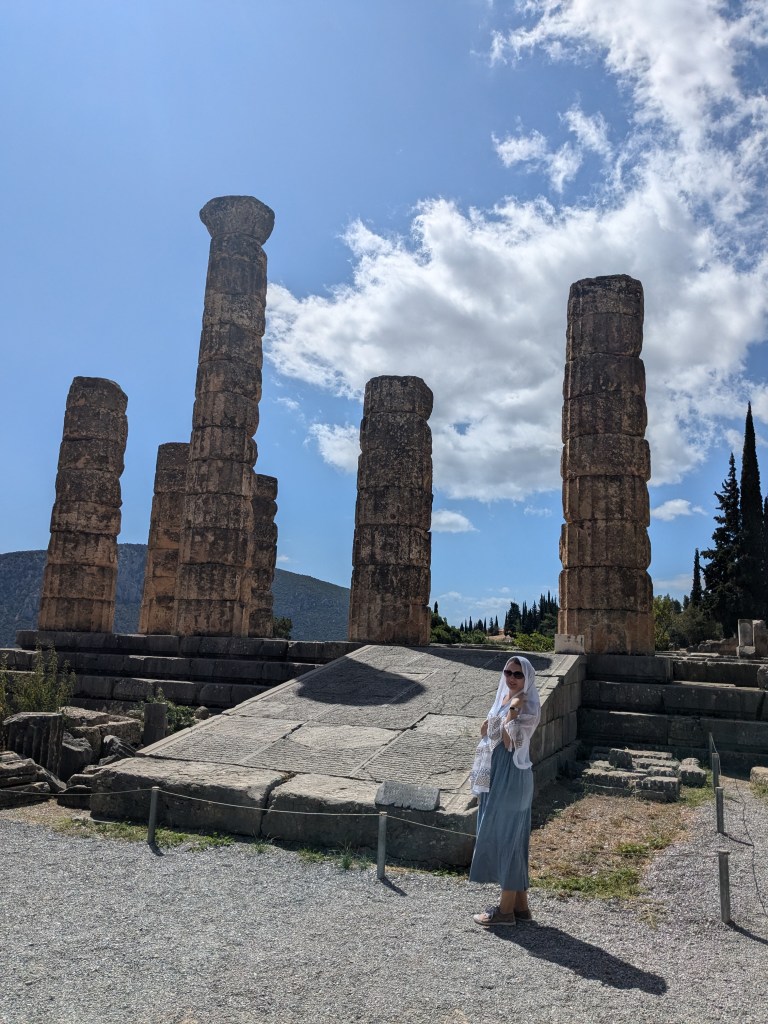
The Temple of Apollo must have been an impressive site in its prime, considering how impressive it is now. Some outer columns remain and tower over visitors. The Oracle, or Pythia as she was called, gave prophecies for only one day a month for nine months of the year. People came from all over the world to receive a prophecy, so the line must have been quite long. Initially a young virgin, the Pythia later became a woman over fifty years old to deter abduction and other unpleasant actions. Various theories explain the source of the prophecies—whether it was a crack in the earth emitting noxious gas causing hallucinations, the chewing of laurel leaves, or indeed the “breath of Apollo” allowing the god to speak through her. Regardless of the source, her power was unquestioned, and her prophecies shaped Greece’s political, social, and economic landscape for centuries.
In addition to the grand temple, there is a theater and stadium to explore. The stadium hosted the Pythian Games, a less prestigious sibling of the Olympic Games. Down on the mountainside, near the entrance, just a few minutes away, is the Castalian Spring. This spring was used by the Pythia and pilgrims for ritual cleansing before prophecies were spoken. Unfortunately, the spring was dry and dusty in the summer heat, and I choose not to dwell on the symbolism.

Temple of Athena Pronaia
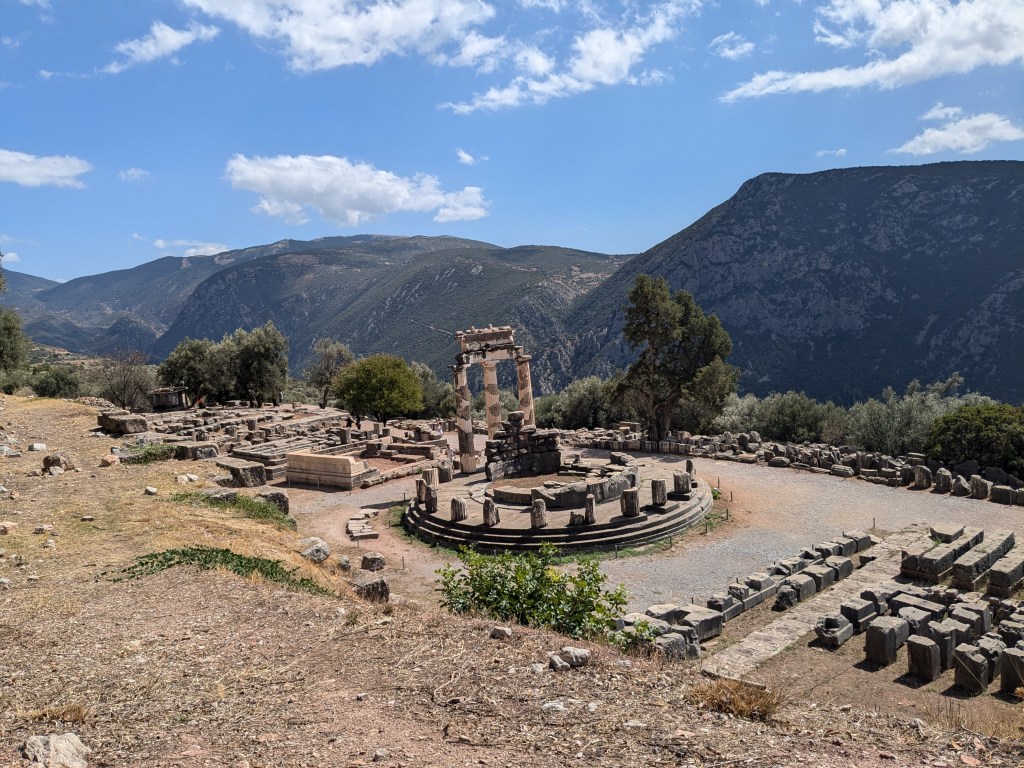
Across the street and down the mountain even more is the Temple of Athena Pronaia, Pronaia being the epithet given to the goddess Athena meaning “the one before”. Pilgrims made a stop here before continuing on to the Temple of Apollo.Another site full of crumbling ruins, it features the Tholos, a rare example of a domed building in ancient Greece, though scholars are unclear about its purpose. The remains of the temple to Athena nearby are among the most photographed in Greece and often appear in searches for Delphi instead of the Temple of Apollo. Why that comes up instead I don’t know, since they are equally impressive.
Arachova

After a late lunch in Delphi town, we stopped in Arachova on the way back to Athens, a well-to-do town on the south slopes of Mount Parnassus. Unlike the Greek Islands that are inundated in the summer, this town is packed full in the winter and hotel prices skyrocket. It’s a ski resort, and many celebrities come here to ski and vacation. There is a clock tower next to the church that towers over the valley, and we climbed to the top of the hill it is on for panoramic views that stretched all the way out to the Gulf of Corinth.
Where Athens is busy and vibrant with life, Delphi is peaceful and quiet in its history. The weight of years presses on the old stone and visitor voices are swiftly carried away on the breeze. It’s well worth a day trip from Athens and will be something I think about for a long time to come, having now joined the thousands of years of pilgrims who came to see the Oracle.

 Sans Peur